
One rainy afternoon in Yorkshire, I made the fatal parenting mistake of saying, “Go on then, tell us a joke.” Three kids stared at me like I’d just asked them to file my taxes. So I grabbed a cereal box, wrapped it in foil, and announced we were hosting a Kids’ Comedy Night. Suddenly everyone had material. Funny how a pretend microphone turns “um…” into “HELLO, LADIES AND GENTLEMEN.”
This is a brilliantly low-stakes way to build confidence, practise speaking, and squeeze in a family giggle without spending a penny (unless you count the cost of glitter getting into places glitter should never be).
Rough timing: about 10 minutes for the microphone, 15 to 20 minutes for the stand, and 20 to 30 minutes for the show (or 90 minutes if someone insists on an encore).
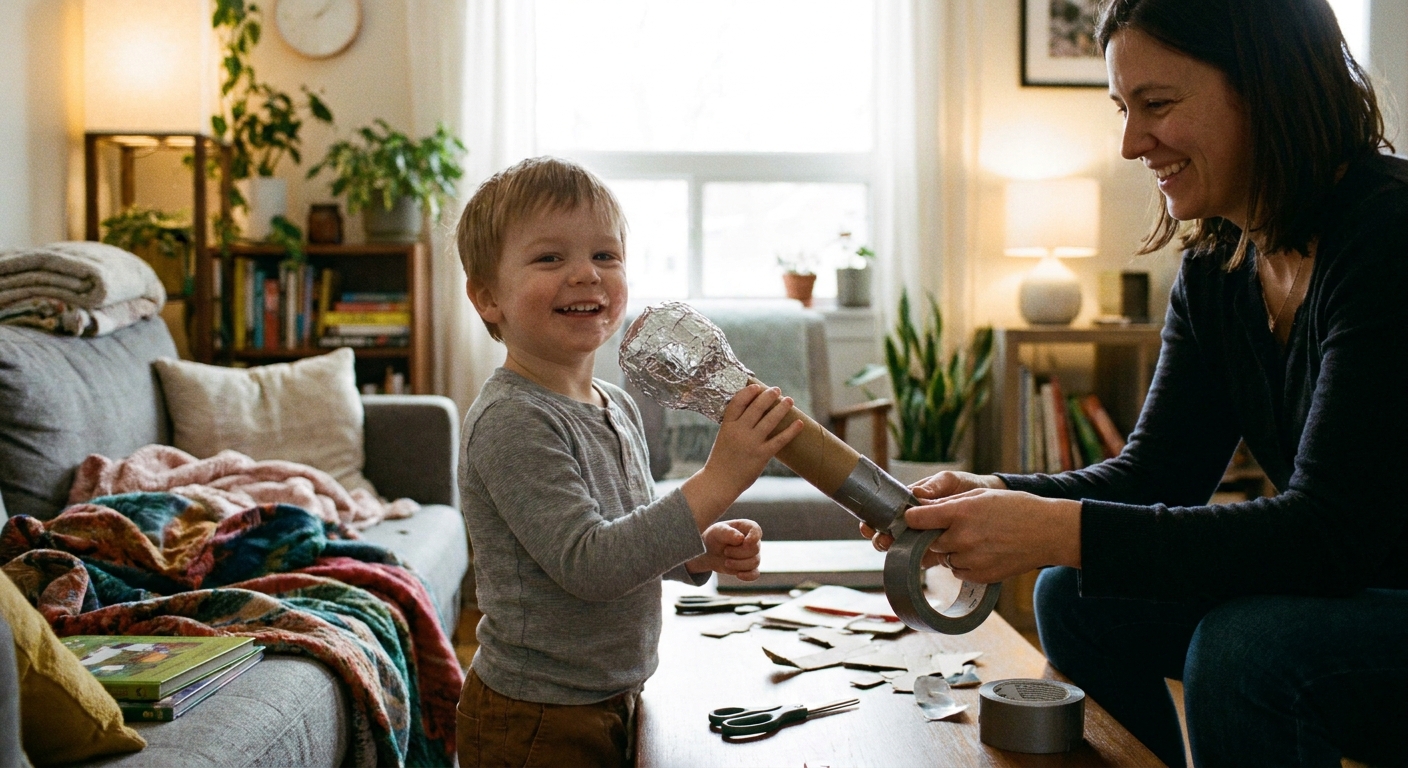
What you’ll need
- Cardboard: cereal box, delivery box, or a kitchen roll tube
- Aluminium foil or grey paper (for the mic head)
- Tape: masking tape or packing tape
- Glue (optional, tape is usually enough)
- Scissors (grown-up job if needed)
- Marker pens or paint for details
- One sturdy base for the stand: an old shoebox, a small box, or a large yoghurt tub
- Something stand-shaped: rolled cardboard tube, wrapping paper tube, or two tubes taped together
If you’ve got them: stickers, washi tape, and a spare bit of sponge or bubble wrap for texture on the mic head.
DIY fake microphone
1) Make the handle
Easiest option: use a kitchen roll tube as the handle. If you do not have one, roll a rectangle of cardboard into a tight tube and tape it along the seam.
- Wrap the handle in black paper, paint it, or just colour it in with marker.
- Add a little “on/off switch” with a small rectangle of paper or tape.
2) Build the microphone head
Take a small cardboard strip (about the length of your hand) and curve it into a ring. Tape it into a circle. This becomes the “rim” of the mic head.
To stop it slumping: tape a simple cardboard “cap” over one side of the ring (a rough circle cut from a cereal box is perfect). Now you have a little cup shape.
- Stuff the inside with scrunched paper to make it nicely rounded.
- Wrap the whole head in foil and smooth it down with your fingers.
- For that dotted mic look, gently press bubble wrap onto the foil to add a tiny pattern. Not required, but it feels properly showbiz.
3) Attach head to handle
Place the head on top of the handle and tape around the join. Use more tape than you think you need. In my house, microphones are mainly used as lightsabers between acts.
4) Finishing touches
- A thin tape line around the rim makes it look “real.”
- Write a pretend brand name like “SUPER MEGA MIC 3000.”
- If your child wants sparkle, accept your fate and deploy the glitter.
DIY microphone stand
A stand is optional, but it adds that proper stage feeling. Plus it gives nervous kids something to lean towards rather than hiding behind the sofa.
Quick sanity check: whatever you make, give it a gentle wobble test before the show. If it tips, widen the base or add weight. “Stable enough for most little rockstars” is the goal, not an A-level in engineering.
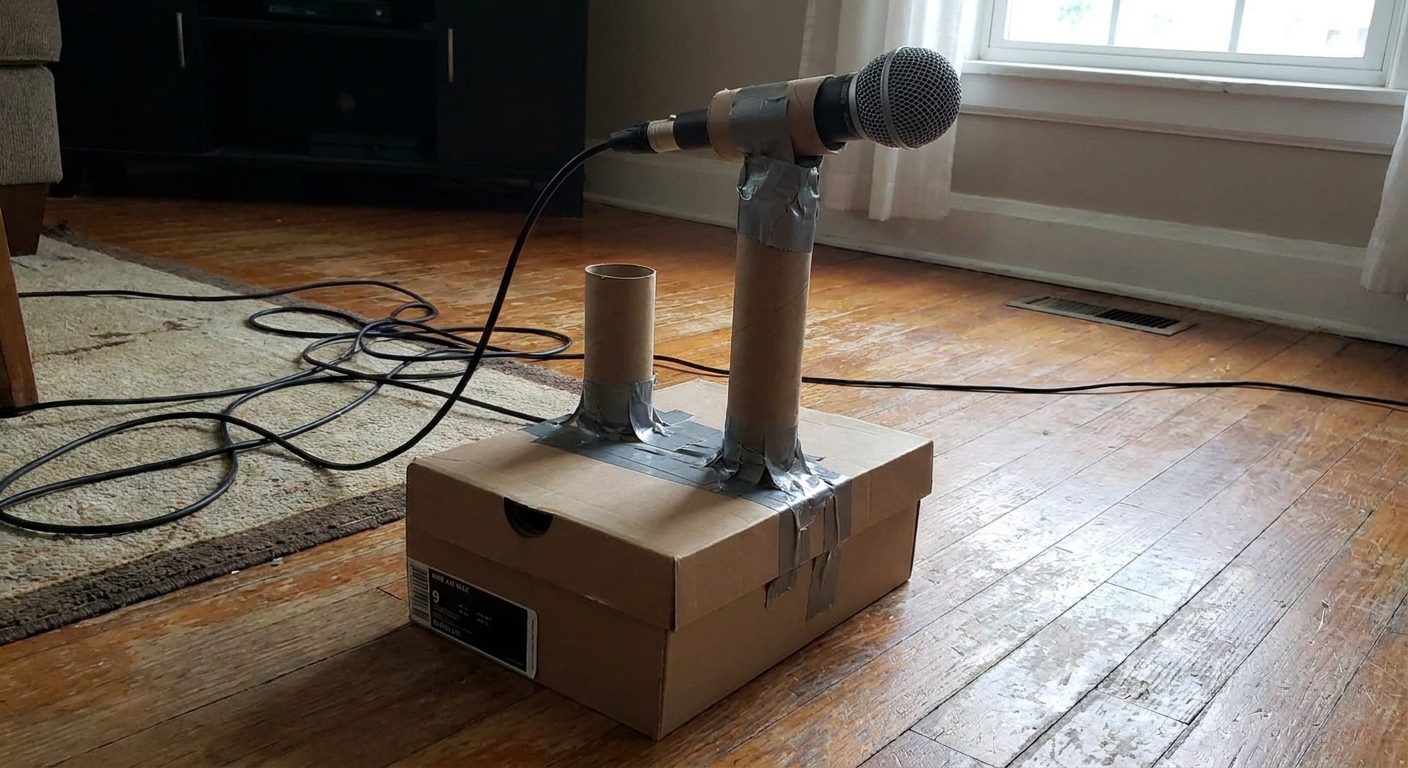
1) Build a strong base
Use a shoebox or small sturdy box. If it feels light, add weight inside (scrunched paper, an old sock, a small book) and tape the lid shut.
2) Add the stand pole
Tape a wrapping paper tube or two taped-together tubes upright onto the base. Use a generous amount of tape in an X shape across the bottom so it does not wobble.
3) Make a microphone clip
Create a simple “C” shaped clip from a strip of cardboard:
- Cut a strip of cardboard about 4 cm wide and 20 cm long.
- Wrap it around the microphone handle and tape it into a loose ring so the mic can slide in and out.
- Tape that ring to the top of the stand pole.
Quick cheat: if you have a large bulldog clip or a clothes peg, you can tape that to the top as a microphone holder. Not fancy, very effective.
Set the scene
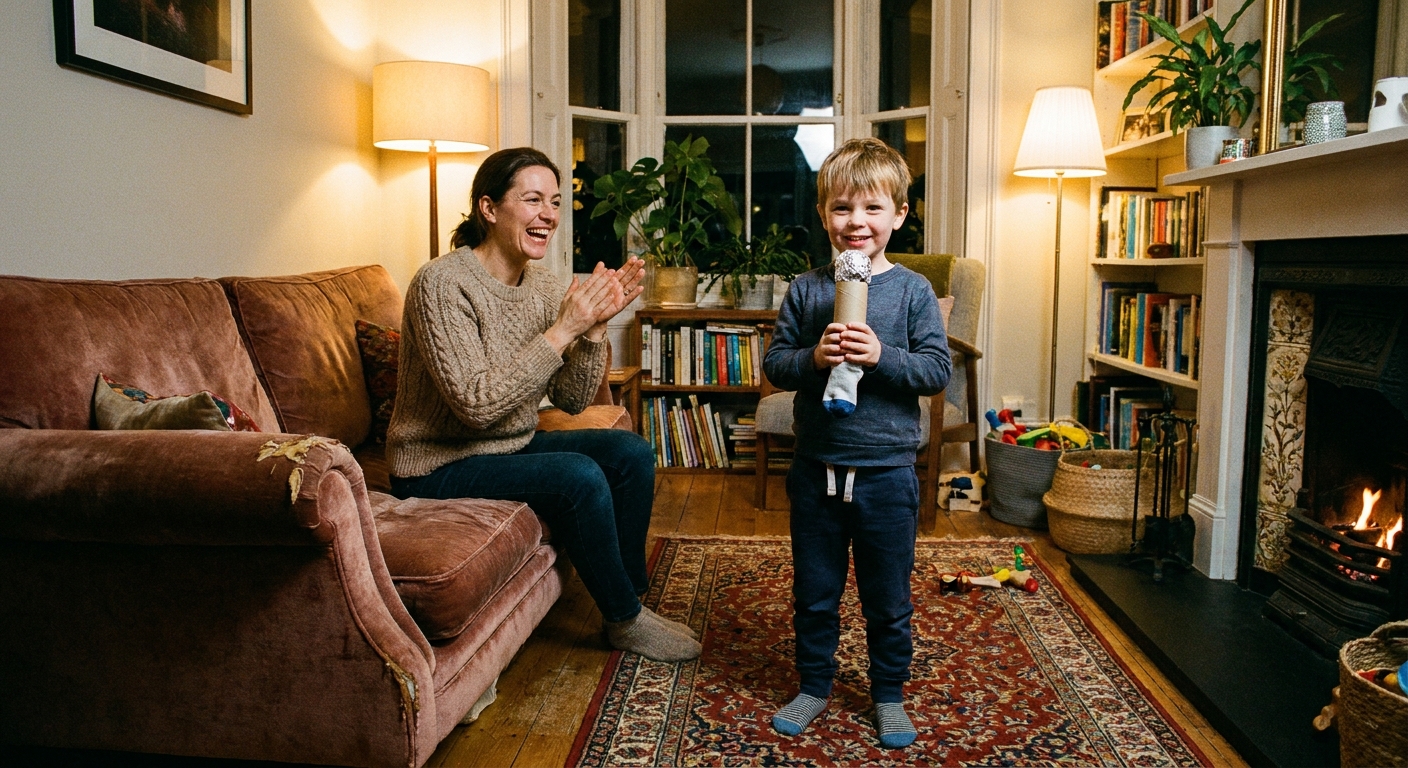
This is where the magic happens. You do not need a stage. You just need a “spot” that feels special.
- Stage: a rug, a taped square on the floor, or the space in front of the sofa
- Spotlight: a lamp aimed at the “stage” (not in anyone’s eyes)
- Audience: family, teddies, or a lineup of dolls who laugh on cue
- Host seat: one chair for you to do serious hosting duties like clapping wildly
House rule from my home: no booing, no teasing, and no “I can do better than that” from siblings. This is a comedy club, not Parliament.
Stand-up basics for kids
Kids do not need a tight five minutes. They need a few simple tricks that make their jokes land and their confidence grow.
1) Start with a hello and a name
Give them a simple opener they can memorise:
- “Hello everyone! I’m ____ and I’m here to tell you some jokes.”
- “Good evening! Please clap politely even if I say something weird.”
That second one is painfully relatable, to be honest.
2) The power of the pause
Comedy timing for kids is mostly this:
- Say the setup. Pause for one beat.
- Say the punchline. Pause again so people can laugh.
If they rush, the joke falls over like a toddler in a too-big coat. You can practise with a silly “1, 2” in your head.
3) Volume and pace
Encourage them to speak a little slower than normal. When kids speed up, jokes turn into a single long word.
- Chin up, eyes forward (at a teddy if real people are scary)
- Big voice, not shouty voice
- Slow down on the punchline
4) Call and response
Give them a line where the audience answers. It reduces pressure because the room joins in.
- Kid: “When I say ‘knock knock’, you say ‘who’s there!’ Ready?”
- Audience: “Who’s there!”
5) A gentle exit line
Ending is the bit kids forget, then they just… stand there… smiling… forever. A closing line helps:
- “Thanks everyone, I’ve been ____! Goodnight!”
- “That’s my time. My mum says I have to be in bed by… whenever.”
Easy joke sets
If your child freezes, it’s usually because they’re trying to hold ten jokes in their head at once. Instead, build a tiny set: one warm-up, two jokes, one closer.
Set idea 1: Knock-knock trio
- Knock, knock.
- Who’s there?
- Owls.
- Owls who?
- Owls it going?
- Knock, knock.
- Who’s there?
- Lettuce.
- Lettuce who?
- Lettuce in, it’s cold out here!
- Knock, knock.
- Who’s there?
- Tank.
- Tank who?
- You’re welcome!
For more family-friendly material, I keep a big stash over in our Kids Jokes guide.
Set idea 2: Silly question jokes
- What do you call a bear with no teeth? A gummy bear.
- What do you call a sleeping dinosaur? A dino-snore.
- Why did the banana go to the doctor? Because it wasn’t peeling well.
Set idea 3: One tiny story
Story jokes are brilliant for kids who enjoy telling tales:
- “Today I tried to help in the kitchen. I made toast.”
- “Then I tried to make it fancy. I added jam.”
- “Then I tried to make it healthier. I added a carrot.”
- “So anyway, dinner is cancelled. Sorry.”
It’s nonsense. That’s the point.
How to host the night
Keep it short
For little ones, aim for 20 to 30 minutes total.
- Welcome from the host (you, wearing something ridiculous if possible)
- First act
- Audience clap break
- Second act
- Optional silly interval game (see below)
- Final act
- Big group bow
Easy transitions: between acts, do a simple intro like “Please welcome to the stage… MY FAVOURITE PERSON WHO LIVES IN THIS HOUSE…!” Then clap like you mean it.
Use clap cues
Some kids worry nobody will laugh. Teach the audience to clap at the end of every act no matter what. You can even practise: “One, two, three, clap!”
Have an interval game
If energy gets wiggly, do a 60-second reset:
- Freeze dance to one song chorus
- Pass the mic: everyone says one silly word into the mic and passes it on
- Two truths and a fib (kid-friendly edition)
If you want more simple family games like that, our Party Games guide is packed with ideas you can run in a living room.
Confidence boosts for shy kids
Not every kid wants to be the headline act. Some want to be the lighting technician and that is a noble calling.
- Let them perform to teddies first. Then add one grown-up. Then add siblings.
- Give them a job. Mic holder, announcer, clap captain, joke judge.
- Offer a buddy act. Two kids telling alternate lines is much less scary.
- Keep expectations tiny. “One joke is enough.” If they do two, you act amazed.
Safety and sanity notes
- Scissors: grown-ups handle tricky cuts, especially thick cardboard.
- Tape: avoid wrapping tape tightly around little wrists and fingers.
- Standing lamp spotlight: keep cords tucked away to prevent trips.
- Small bits: keep bulldog clips, loose tape pieces, tiny decorations, and glitter pots away from under-3s. Cardboard projects have a sneaky way of shedding little chokey bits.
- Glitter: if you open it, you have accepted it into your family forever.
Comedy Night add-ons
Make a joke prop
If your kids like props, an origami fortune teller works brilliantly as a “joke chooser.” We have a full folding guide here: Origami Joke Teller Folding Guide and 40 Funny Prompts.
Turn jokes into a game
If you want a structured way to keep jokes flowing, try our Make a Kind Joke Card Game. It’s a lovely way to steer kids towards humour that does not punch down.
Add a craft warm-up
If you want to do crafts first, then comedy, hop over to the Kids Crafts guide for easy makes using household bits.
Mini FAQ
What age is this best for?
I’ve done versions of this from about age 3 up to 12. Younger kids can do one joke or one funny sound. Older kids can try a short set with pauses and a closing line.
What if my child’s jokes are rude?
Totally normal. I set one rule: we tell jokes that make people feel good. If they really want to tell a cheeky one, I offer a swap: “Save that for the bathroom, mate. Pick one for the stage.”
How do I stop siblings heckling?
Give hecklers a job. Make them the clap captain or the mic assistant. Also, remind them they’re on next.
Can we do this without a stand?
Yes. The microphone alone is enough. The stand just adds theatre and gives fidgety hands somewhere to aim.
One last thing
The best bit is not the jokes. It’s that moment when your child realises everyone is listening and smiling, and they think, “Oh! I can do this.”
Quick clean-up tip: do a “stage sweep” at the end. One grown-up with a bin bag, one kid on tape patrol, and someone in charge of returning the glitter to whatever glitter dimension it came from.
And if the whole evening ends with you picking foil confetti out of the carpet while somebody yells “Owls it going?” from upstairs, congratulations. You’ve done Kids’ Comedy Night correctly.
If you want more giggles for your next show, browse the Kids Jokes guide, and if you ever need to get in touch with the site, you can find me via the contact page.