

The first time I tried making a “comedy” tumbling tower, I confidently handed it to my kids like I was presenting a brand-new board game… and immediately learned a vital parenting truth: if you paint wooden blocks with wet jokes (as in, wet paint), the jokes become modern art. Abstract, sticky, and stuck to the dog.
So here’s the version that actually works. You’ll take a plain wooden block stacking set, paint it in bold party colours, then add a joke setup on one side and the punchline on the opposite side. Every time someone pulls a block, they read the setup, and when it gets placed on top, everyone gets the punchline. The tower wobbles, the jokes land (mostly), and the giggles do the heavy lifting.
What you’ll need
- A blank wooden tumbling tower (most standard sets work, often around 54 blocks)
- Acrylic paint in 4 to 6 bright colours
- Paintbrush (medium flat brush is easiest)
- Fine paint pen or permanent marker for writing jokes
- Clear water-based varnish (optional, but highly recommended for party durability)
- Masking tape (optional, for sharp colour blocks)
- Sandpaper (fine grit, optional, if blocks feel rough)
- Newspaper or a wipe-clean table covering
My thrifty note: If the blocks are already a bit glossy, a very light sand helps paint stick better. If they’re unfinished wood, you’re good to go.
Legibility tip: Pair light paint with dark writing (or dark paint with a white paint pen). The fun wears off fast if nobody can read the punchline.
How the joke sides work
Each block has:
- Side A: the joke setup (question or first line)
- Side B (opposite side): the punchline
That way, when a block is pulled, the player reads the setup aloud. Then when they place it on top, the punchline is revealed to the room. It builds a silly little rhythm as the tower grows.
Tip: Keep writing on the long sides only. Avoid the short ends, because they get rubbed constantly during stacking and sliding.
Paint and build your Comedy Tower
1) Quick prep (active time: about 5 minutes)
Wipe the blocks with a dry cloth. If they feel splintery, give them a fast once-over with fine sandpaper. You’re not carving a sculpture, just saving fingers from surprise splinters mid-party.
2) Paint in batches (active time: 20 to 40 minutes, plus drying)
Pick 4 to 6 colours and paint the blocks in sets. I like doing colour “families” so it looks intentional even when the tower is doing its best impression of a giraffe on roller skates.
- Paint the outside faces you’ll see when stacked (both long sides, plus the short ends if you like)
- Let dry fully
- Do a second thin coat if the wood shows through, then let dry again
Important: You will be writing over the paint once it is fully dry, so painted long sides are exactly what you want.
Drying tip: Stand blocks on their ends on a scrap of cardboard so they don’t glue themselves to your table. Ask me how I know.
3) Add the jokes (active time: 15 to 30 minutes)
Once the paint is completely dry, write the setup on one long side and the punchline on the opposite long side.
Writing tips that save sanity:
- Keep it short. Aim for 4 to 9 words per side.
- Use a paint pen for bold, readable text.
- If you are prone to “interesting” handwriting, go ALL CAPS.
- Lightly pencil the words first, or do one practice block to get your spacing right.
How many blocks should you label? If you are short on time, label 20 to 30 blocks and leave the rest plain. It still plays brilliantly. If you are feeling heroic (or you just want quiet crafting time), label the whole set. Repeating a few favourites is also completely allowed in this house.
4) Seal it (optional, but party-proof)
Brush on a thin coat of water-based varnish. This stops sweaty kid hands from smudging your best material.
Drying reality check: “Touch-dry” is not the same as “ready for a pack of excited children.” If you can, leave the blocks to dry overnight before you seal them and before you play. If you rush, you will end up with fingerprints on every punchline. They will look like tiny comedy ghosts.
Kid-friendly joke pairs
Here are some quick setup and punchline pairs sized to fit on blocks. Mix and match, and absolutely let kids invent their own. The groanier the better.
- Setup: Why did the banana blush?
Punchline: It saw the smoothie bar. - Setup: What do clouds wear?
Punchline: Thunderwear. - Setup: What do you call cheese that isn’t yours?
Punchline: Nacho cheese. - Setup: Why did the cookie go to hospital?
Punchline: It felt crummy. - Setup: What do you call a sleeping dinosaur?
Punchline: A dino-snore. - Setup: Why can’t your nose be 12 inches?
Punchline: Because then it’d be a foot. - Setup: What do you call a bear with no teeth?
Punchline: A gummy bear. - Setup: Why did the scarecrow win an award?
Punchline: He was outstanding in his field. - Setup: What do you call a fake noodle?
Punchline: An impasta. - Setup: What do you get from a pampered cow?
Punchline: Spoiled milk. - Setup: Why did the maths book look sad?
Punchline: It had too many problems. - Setup: What did one wall say to the other?
Punchline: I’ll meet you at the corner.
If you want a bigger stash, our kids jokes guide is handy for finding the kind of jokes that get laughs without any awkward party explaining.
How to play at a party
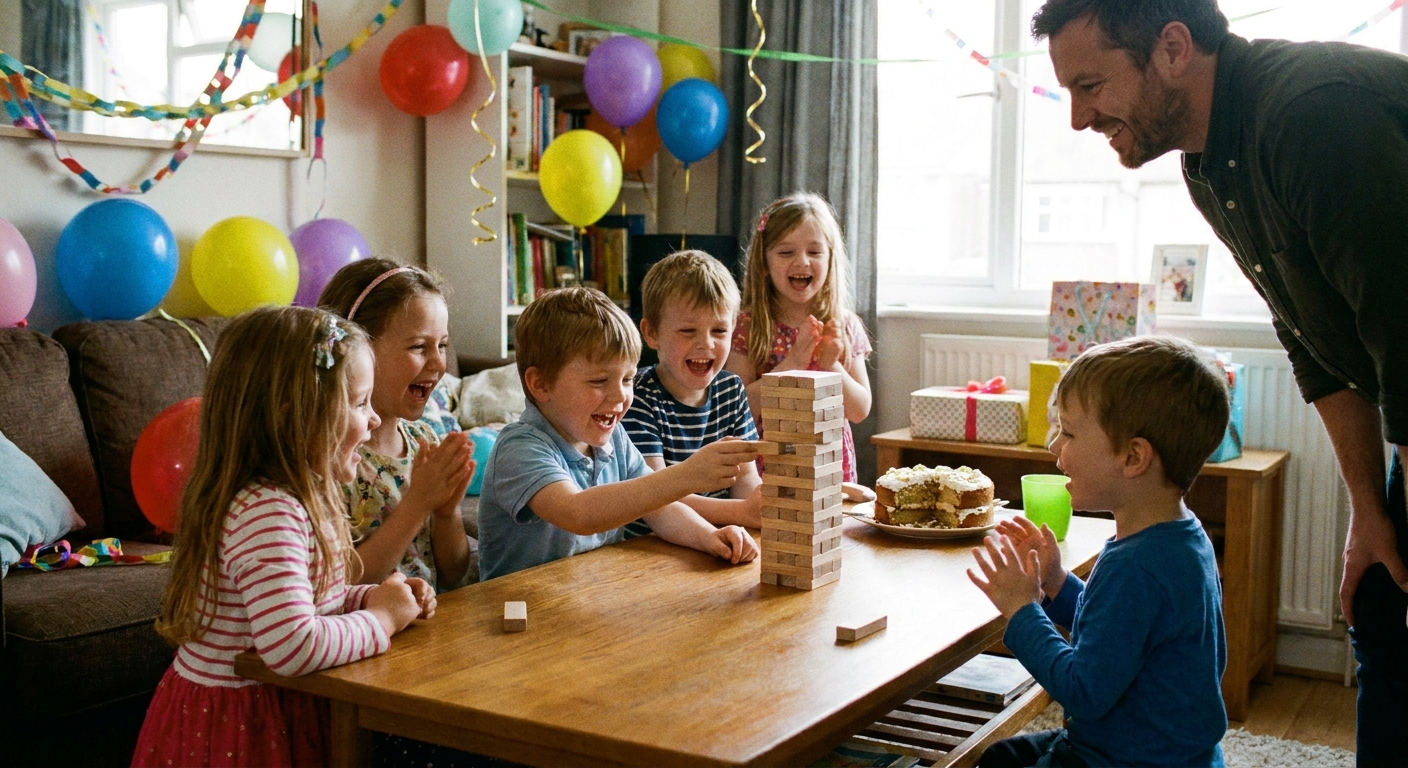
You can play it like a normal tumbling tower, but adding just a few “comedy rules” turns it into a proper party game.
Rule set A: Setup now, punchline later
- When you pull a block, read the setup out loud.
- Place the block on top with the punchline facing outward.
- The whole group reads the punchline together.
Rule set B: Laugh or stack
- Read the setup.
- If at least one person laughs at the punchline when it’s revealed, you’re safe.
- If nobody laughs, you must pull one extra block. Harsh, but fair.
Rule set C: Team tower
Split into two teams. Each team gets a colour. If you pull your team colour, your team tells the joke. If you pull the other colour, you must deliver it in a silly voice. This is where grandparents unexpectedly shine.
Want another DIY party game that feels gloriously chaotic? Pair this with Pass the Laugh (multi-layer parcel game) for peak living-room mayhem.
Colour categories
If you paint by colour, you can turn the tower into a mini game show. Here are easy categories that work for mixed ages:
- Red: animal jokes
- Blue: school jokes
- Green: food jokes
- Yellow: “what am I?” riddles
- Purple: silly dares (keep them gentle)
If you add dares: Keep them quick and kind, and steer clear of food-based dares. It avoids allergy worries, sensory overload, and the kind of chaos that ends with someone dramatically announcing they are “never eating yoghurt again.”
For dare-style party fun, you might also like Feed the Monster Bean Bag Toss.
Safety and sanity notes
- Age guidance: The tower itself is best for ages 6+. Younger siblings can help paint and decorate, then “judge” the jokes.
- Use water-based, non-toxic paint: Acrylic craft paint is usually fine, but check labels.
- Let everything dry fully: If you rush, you will end up with fingerprints on every punchline.
- Watch the stacking surface: A hard, flat table makes the game fair. A thick carpet makes it feel like the tower is melting.
Troubleshooting
The marker smears
The paint probably was not fully dry, or the marker is too juicy. Let the blocks dry longer, then re-write with a paint pen. Sealing with varnish after writing helps a lot.
The blocks stick when stacking
Too much paint or varnish can make them tacky. Keep coats thin and allow proper drying time. If they’re already sticky, leave them somewhere warm and dry for a day, then lightly sand any rough spots.
My jokes do not fit
Shorten the setup. You can also use symbols for repeat words. For example, use a tiny banana doodle instead of writing “banana” for the 12th time. The goal is laughter, not perfect calligraphy.
More party game ideas
If your house is currently in “party mode,” here are a few more you can make with simple supplies:
- Pin the Punchline (a classic party game twist)
- Balloon Pop Joke Dart Board (big energy, big laughs)
- Funny Photo Booth Props (perfect for party photos)
And if you want the full category browse, pop over to our Party Games guide.